ACM Multimedia 2026 · Rio de Janeiro, Brazil

MER2026 Challenge
& MRAC2026 Workshop

From Discriminative Emotion Recognition to Generative Emotion Understanding — the 4th edition of the MER series, featuring four new tracks.

4th
Edition
4
Tracks
Nov 2026
Rio de Janeiro

What is MER2026?

MER2026 marks the fourth edition of the MER series of challenges. The MER series provides valuable data resources to the research community and offers tasks centered on recent research trends, establishing itself as one of the largest challenges in the field. Throughout its history, the focus of MER has shifted from discriminative emotion recognition to generative emotion understanding. Specifically, MER2023 concentrated on discriminative emotion recognition, restricting the scope to fixed basic labels. In MER2024 and MER2025, we transitioned to generative emotion understanding, leveraging the extensive vocabulary and multimodal understanding capabilities of MLLMs to facilitate fine-grained and explainable emotion recognition. Building on this trajectory, MER2026 contains four tracks: MER-Cross, MER-FG, MER-Prefer, and MER-PS.

Contact: merchallenge.contact@gmail.com  ·  lianzheng@tongji.edu.cn

News

Apr 30, 2026 We establish an initial website for MER2026 Challenge and MRAC2026 Workshop.

Four Challenge Tracks

🗣️
Track 1

MER-Cross: Interlocutor Emotion

A newly introduced track that shifts focus from individual scenarios to dyadic interactions. When speaker s₁ is talking, MER-Cross targets the emotion of the listening s₂ (interlocutor) rather than the speaker, enabling capture of both sides of a conversation.
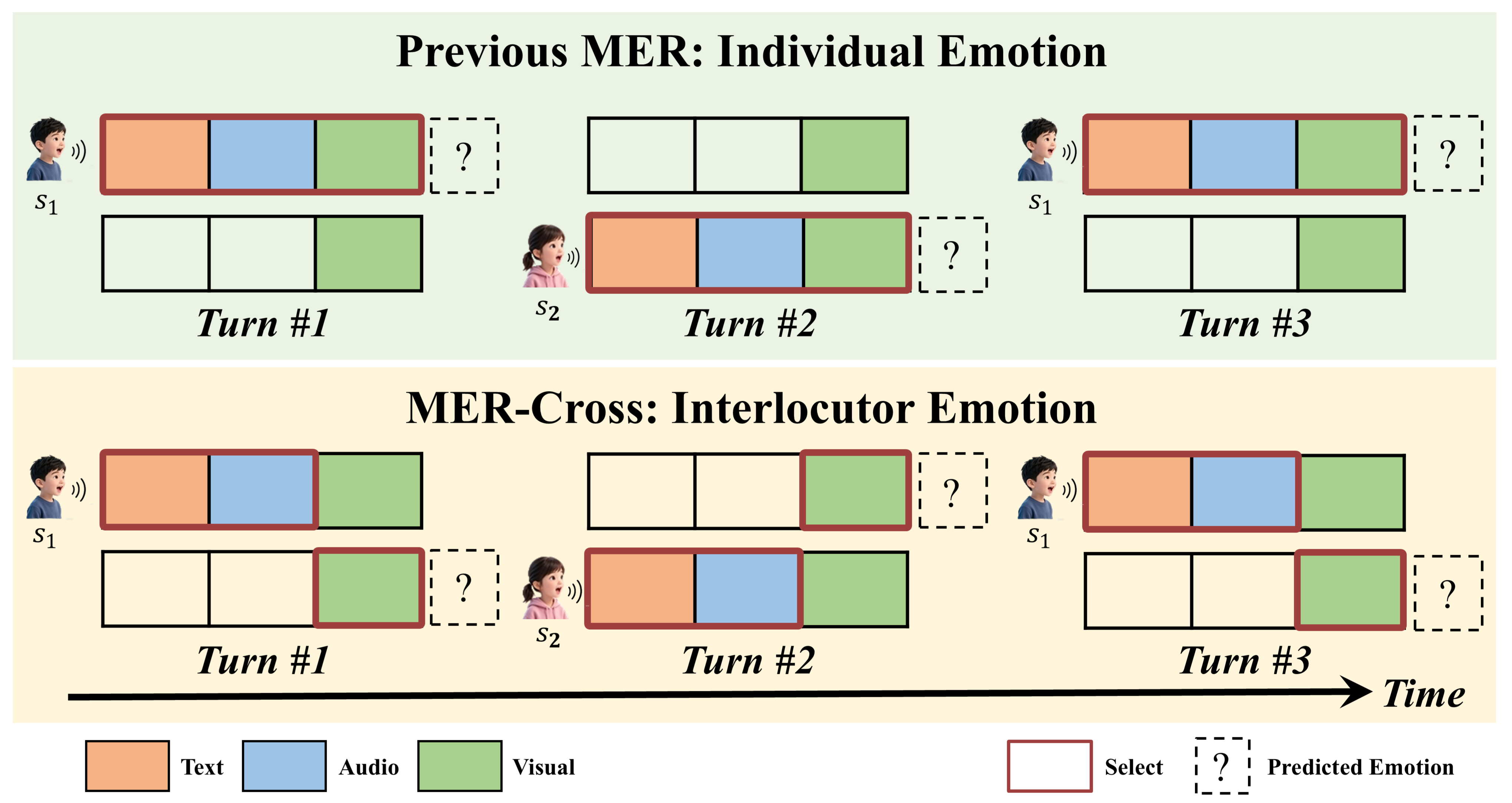
MER-Cross illustration
MER-Cross: predicting the interlocutor's emotion in dyadic interactions.
🔍
Track 2

MER-FG: Fine-grained Emotion

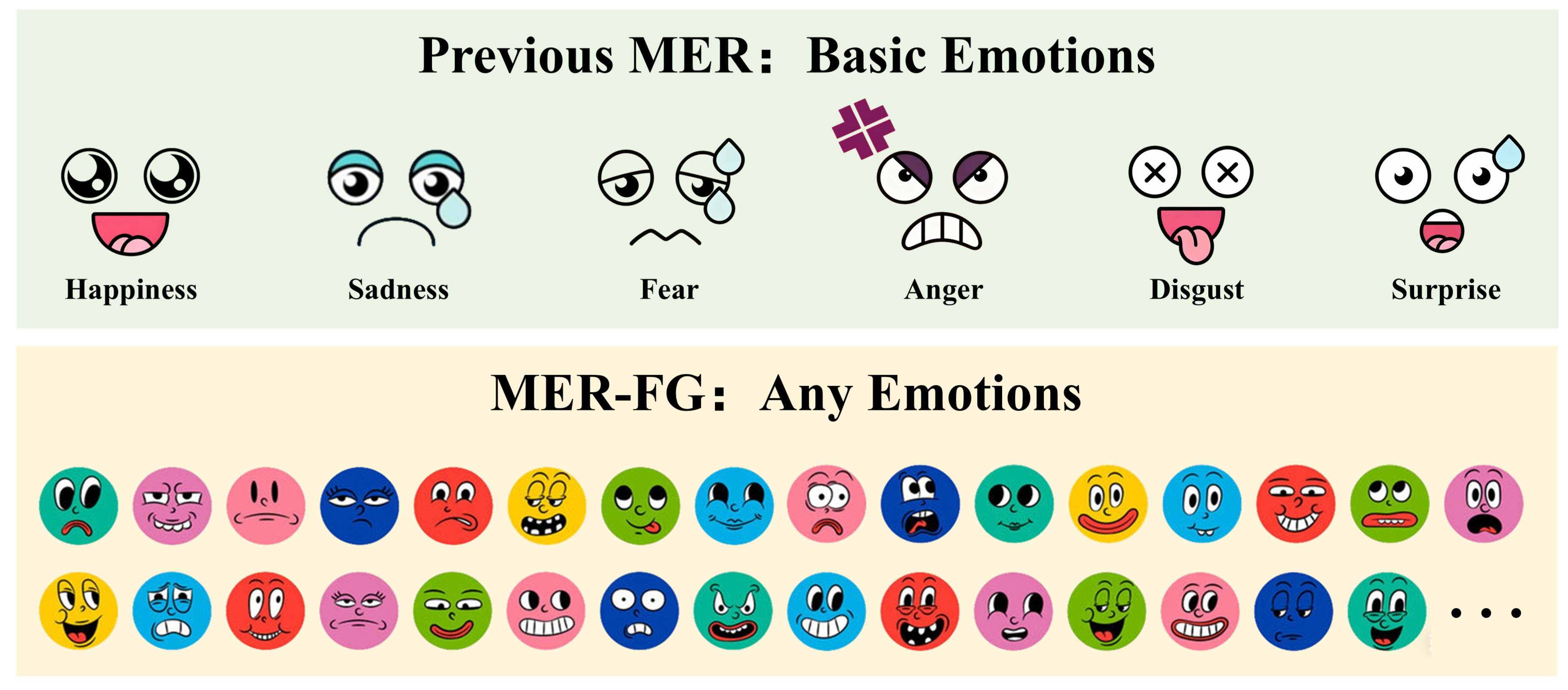
Human emotion extends far beyond basic labels. In this track, participants can predict any number of emotion labels across diverse categories, expanding recognition scope from basic to more nuanced emotions.
MER-FG illustration
MER-FG: open-vocabulary emotion recognition beyond basic categories.
⚖️
Track 3

MER-Prefer: Emotion Preference

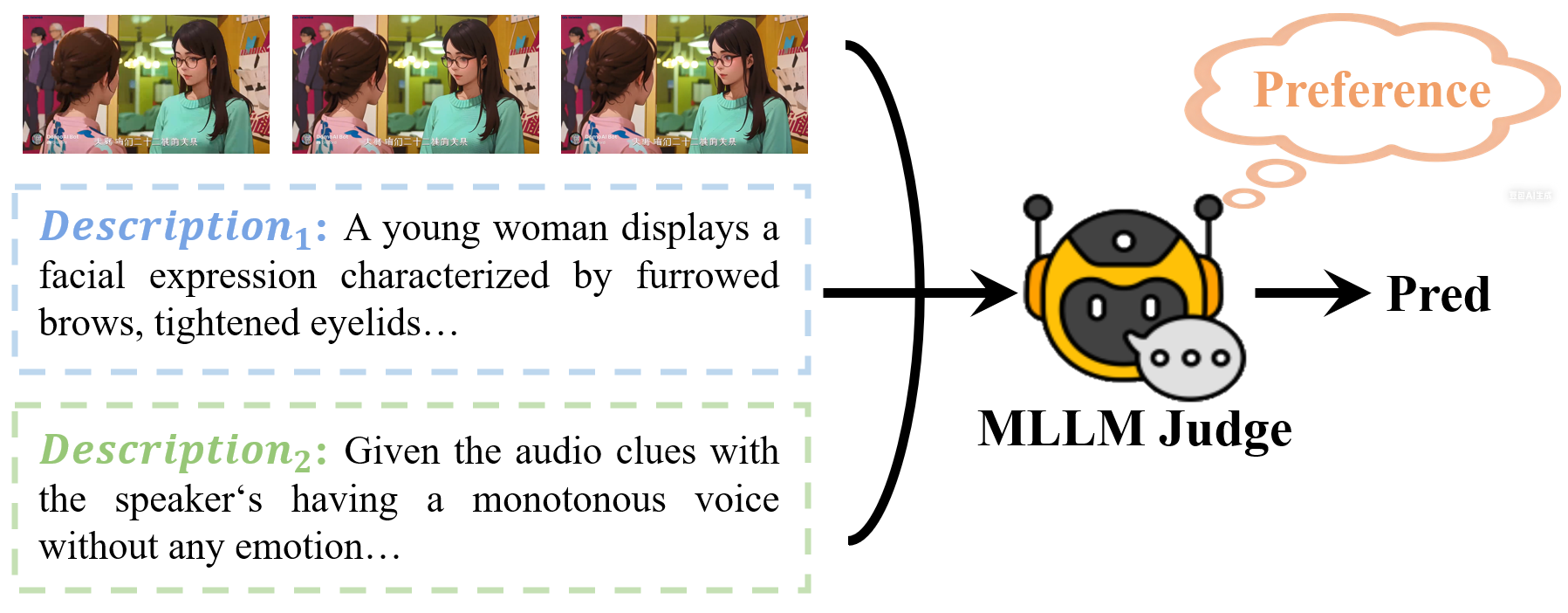
A newly introduced track predicting which of two emotion descriptions is preferred by human annotators for a given video — a critical component for training reward models in emotion understanding.
MER-Prefer illustration
MER-Prefer: determine which emotion description humans prefer.
🧠
Track 4

MER-PS: Physiological Signal Emotion

Shifts emotion recognition from observable behaviors to physiological evidence. Using synchronized EEG (64-ch, 1000 Hz) and fNIRS (51-ch, 47.62 Hz) signals from 30 participants watching 15 emotion-eliciting video clips.

A key feature is real-time dynamic emotion annotation — subjects continuously report valence and arousal via joystick at 1 Hz. The goal is to estimate the valence–arousal trajectory from brain signals.

[1] Zheng Lian et al. MER 2023: Multi-label Learning, Modality Robustness, and Semi-supervised Learning. Proceedings of the 31st ACM International Conference on Multimedia, 2023.

[2] Zheng Lian et al. MER 2024: Semi-supervised Learning, Noise Robustness, and Open-vocabulary Multimodal Emotion Recognition. Proceedings of the 2nd International Workshop on Multimodal and Responsible Affective Computing, 2024.

[3] Zheng Lian et al. MER 2025: When Affective Computing Meets Large Language Models. Proceedings of the 33rd ACM International Conference on Multimedia, 2025.

[4] Zheng Lian et al. Explainable Multimodal Emotion Reasoning. arXiv:2306.15401, 2023.

[5] Zheng Lian et al. OV-MER: Towards Open-Vocabulary Multimodal Emotion Recognition. Forty-second International Conference on Machine Learning (ICML), 2025.

[6] Zheng Lian et al. AffectGPT: A New Dataset, Model, and Benchmark for Emotion Understanding with Multimodal Large Language Models. Forty-second International Conference on Machine Learning (ICML), 2025.

[7] Zheng Lian et al. EmoPrefer: Can Large Language Models Understand Human Emotion Preferences? International Conference on Learning Representations (ICLR), 2026.

[8] Zheng Lian et al. AffectGPT-R1: Leveraging Reinforcement Learning for Open-Vocabulary Multimodal Emotion Recognition. arXiv:2508.01318, 2026.


Workshop Topics & Submission

🎯 Research Topics

  • Large-scale data generation / inexpensive annotation for Affective Computing
  • Generative AI for Affective Computing using multimodal signals
  • Multi-modal methods for emotion recognition
  • Privacy-preserving large-scale emotion recognition in the wild
  • Affective Computing in education, entertainment & healthcare
  • Explainable or Privacy-Preserving AI in affective computing
  • Semi-/weak-/un-/self-supervised learning for Affective Computing
  • Physiological signal-based emotion recognition (EEG, fNIRS, etc.)
  • Dyadic and group emotion recognition in interaction scenarios
  • Reward modeling and preference learning for emotion understanding

📋 Submission Guidelines

Format: ACM double-column template (paper template). Double-blind review — anonymize all author information.

Length:

  • Option A: 4 pages + 1-page references
  • Option B: 8 pages + up to 2-page references

Review: All papers peer-reviewed; accepted papers published in the ACM Digital Library.

Submit Your Paper to MRAC2026

Challenge solutions and any work on multimodal affective computing are welcome.

Coming Soon

Schedule

All deadlines at 23:59 Anywhere on Earth (AoE).

Apr 30, 2026
Data, baseline paper & code available
Jun 26, 2026
Results submission opens
Jul 13, 2026
Results submission deadline
Jul 22, 2026
Paper submission deadline
Jul 30, 2026
Paper acceptance notification
Aug 06, 2026
Camera-ready paper deadline
Nov 10–14, 2026
ACM Multimedia 2026 — Rio de Janeiro, Brazil

Speakers

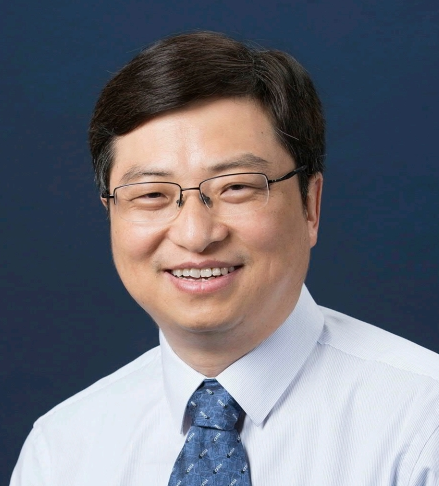
Qin Jin
Full Professor
Renmin University of China
Talk Title
Coming Soon
Abstract
Coming Soon
Dimitrios Kollias
Associate Professor
Queen Mary University of London
Talk Title
From Affect Recognition to Behaviour-Centric AI: The Next Frontier in Multimodal AI
Abstract
Multimodal emotion recognition has achieved remarkable progress, yet it continues to face various limitations, including challenges in representation, generalisation and evaluation. In this keynote, I argue that the field is reaching a critical transition point: moving towards a more principled, behaviour-centric understanding of human affect. I will reflect on this shift through a series of works spanning large-scale in-the-wild datasets and unified modelling frameworks, highlighting both key advances and the structural challenges that remain. I will further discuss emerging directions that seek to ground multimodal emotion recognition in richer, semantically meaningful representations. Building on these insights, I will outline a forward-looking research agenda focused on dynamic affect modelling, generative facial behaviour and fair domain generalisation - pointing towards the next generation of multimodal AI systems that are more robust, interpretable and socially aware.

Organizers

General Chairs
Jianhua Tao
Tsinghua University
Zheng Lian
Institute of Automation, CAS
Björn W. Schuller
TU Munich & Imperial College London
Guoying Zhao
University of Oulu
Erik Cambria
Nanyang Technological University
Challenge Chairs
Xiaojiang Peng
Shenzhen Technology University
Kele Xu
National University of Defense Technology
Fei Ma
Guangdong Lab of Artificial Intelligence and Digital Economy (SZ)
Ziyu Jia
Institute of Automation, CAS
Laizhong Cui
Shenzhen University
Zebang Cheng
Shenzhen University
Workshop Chairs
Yazhou Zhang
Tianjin University
Xin Liu
Shanghai Jiao Tong University
Yan Wang
East China Normal University
Liang Yang
Dalian University of Technology
Jia Li
Hefei University of Technology
Fan Zhang
CUHK

Acknowledgement

We would like to express our sincere gratitude to the Dataset Chairs for their support during the dataset construction process: Xiaojiang Peng (Shenzhen Technology University), Kele Xu (National University of Defense Technology), Fei Ma (Guangdong Lab of Artificial Intelligence and Digital Economy (SZ)), Ziyu Jia (Institute of Automation, CAS), Laizhong Cui (Shenzhen University), and Zebang Cheng (Shenzhen University). We also thank the members of our Annotation Team for their efforts: Zelin Yan (Tongji University), Liyi Liu (Tongji University), Chenxi Zhou (National University of Defense Technology), Yuan Cao (National University of Defense Technology), Kaiyao Li (Shenzhen University), Dawei Huang (Shenzhen University), and Hanwen Du (Shenzhen University). Finally, we thank the ACM Multimedia 2026 Challenge Chairs for giving us the opportunity to organize MER2026 at this premier conference.